
FAQ & Glossary
Frequently Asked Questions
Product
The west side of our home gets hot in the afternoon, what can I do?
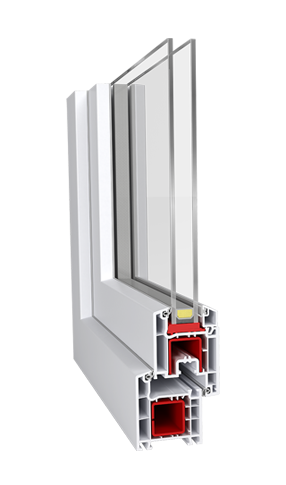
This is where low emissivity (or soft coat low–e glass) coatings come into play. Low–E glass has a microscopically thin, transparent coating—it is much thinner than human hair and it reflects long-wave infrared energy back into your home (or heat). Some low–e’s also reflect significant amounts of short-wave solar infrared energy and this depends on what surface the Low-E is put on.
How do I stop my room from getting too hot in summer?
Shading is the ideal way to block the sun from heating up your room. This could be with eaves or a pull-down blind on the outside. Low e glass is available and this will help deflect the heat on sides that don’t receive a winter benefit.
How do I stop my furnishings from fading from the sun?
With the double glazed unit, we would put a 6.38 laminate on the outside pane and a 4mm on the inside pane. The laminate provides 99.9% protection over UV entering your home that causes fading. The 6.38 laminate also makes your home quieter and provides protection against breakage providing better security.
Does double glazing protect my house from smoke or fire?
By installing new double glazed units, window frames are sealed from the elements. This helps to stop wind, smoke and pollution from entering your home.
The glass used in double glazing can also help to protect your home from fire by insulating the heat entering the building.
Our uPVC frames are BAL rated and self-extinguishing. For high BAL ratings we must use aluminium mesh screens and thicker glass.
What is a ‘U-value’?
A U-value, also known as thermal transmittance, measures how well a building element (such as a window, door, or wall) conducts heat. It indicates the rate of heat transfer through the material, with lower U-values representing better insulation properties. Essentially, the lower the U-value, the more effective the material is at keeping heat inside during the winter and outside during the summer, thus improving a building’s energy efficiency.
Do you have accessible options for doors?
Yes, our hinged doors and lift and slides have a low aluminium threshold. We can also provide near zero thresholds with the Alumat Magnetic Threshold.
Do you have privacy glass?
If you are looking for obscure glass, there are several types of glass to choose from, depending on the style. We also offer tinted glass, which is dark and private from the outside, with uninterrupted views from the inside. If you are interested in mirror tinting we can work with a company to provide a film to achieve this look.
What options do you have for servery windows?
There are several options for servery windows:
• stacking
• push out casement
• gas strut awning
• swing and slide
Do you offer triple glazing?
We can certainly provide triple glazing if required. We can also achieve the same ratings with low emissivity glass.
Can you replace windows in a heritage listed home?
Yes, we have worked on several heritage projects where we were able to replicate the look of the original windows to abide by the replacement guidelines. We offer frames with a timber-look and georgian bar glass units, if required.
Can I keep my old frames and just replace the glass?
At Solace Creations, we specialise in replacing both the frames and glass with insulated products. This ensures that the highest energy efficiency is achieved with less draughts. Standard aluminium and steel frames conduct heating and cooling, while timber frames are often leaky and hard to maintain.
Does Double Glazing Eliminate Condensation?
While double-glazed uPVC windows and doors can reduce condensation, they do not guarantee the elimination of condensation if the humidity level is higher than 60% in the home.
Is double glazing worth it in Canberra?
Yes. Canberra is one of Australia’s coldest cities. Single-glazed windows are a major source of heat loss in winter and heat gain in summer. Double glazing can reduce heat transfer through your windows by up to 70%. Insulated windows and doors alone can cut energy bills by up to 45%, and up to 75% when paired with solar panels. Most Canberra homeowners notice improved comfort within days of installation, and the energy savings compound over time.
How much does double glazing cost in Canberra?
The cost depends on the number of windows and doors, opening styles, glass types, frame colour, and whether the project is a replacement or a new build. As a general guide, uPVC double-glazed windows start from approximately $900–$1,200 per window for standard-sized tilt and turn or awning windows. Larger units, sliding doors, and special order colours are priced accordingly. The best way to get an accurate project cost is to request a free, no-obligation consultation. Solace Creations provides fixed-price quotes with no hidden costs.
How long does it take to recoup the cost through energy savings?
Most Canberra homeowners see a meaningful reduction in heating and cooling costs within the first year. The payback period varies by home size and usage. However, for a typical Canberra home, replacing all windows and doors, energy savings alone often recover the investment within 8–15 years, and comfort improvements are immediate. Double glazing also adds to the resale value of your home, which contributes to the overall return.
Does double glazing add value to my home?
Yes. Double-glazed windows and doors are a recognised home improvement that adds to the value and appeal of a property, particularly in Canberra where energy efficiency is a strong selling point. Upgrading your windows and doors with double glazing raises your EER level which makes your home more comfortable. Updating windows and doors modernises your home’s exterior appearance and is increasingly expected by buyers in the Canberra market.
What is the difference between uPVC and aluminium window frames?
uPVC frames are significantly better insulators than aluminium frames. Aluminium is a metal that readily conducts heat. This means that even with double-glazed glass, aluminium frames can create thermal bridging cold spots at the edges, undermining the performance of the glass unit. uPVC frames are non-conductive, eliminating this problem entirely. They also require no painting, sealing, or rust treatment. Solace Creations uses only uPVC frames for these reasons.
Services

What is the turnaround time?
Once the deposit is paid, your order is placed in our delivery schedule. The standard turnaround time is 5-12 weeks and longer for special order colours.
Where are your windows and doors fabricated?
We supply uPVC frames and double-glazed glass units that are fabricated in Sydney and Melbourne.
The frames are delivered by our professional removalist companies while the glass is delivered by the glass suppliers.
What area do you provide to?
Solace Creations is a local Canberra company that provides windows and doors to the greater ACT and surrounding NSW areas. We typically can travel 1-2 hours outside of Canberra.
Can I replace windows in a strata or apartment building?
Yes, however you will usually need:
-
Body corporate approval
-
Documentation showing the new windows comply with building standards
-
Confirmation that the external appearance will be consistent with the building
We can assist by providing technical details, drawings, and WERS ratings for your submission.
What warranties do you provide?
All our windows and doors come with comprehensive warranties that cover:
-
uPVC frames
-
Glass units
-
Hardware
-
Installation workmanship
Because we are a local Canberra company, we provide ongoing after-sales support, something interstate suppliers cannot always guarantee.
What certifications or ratings do your windows comply with?
Our uPVC window and door systems meet or exceed:
-
Australian Standards AS 2047 and AS1288 (Windows in Buildings)
-
BAL ratings up to BAL-40 (when paired with the correct glass)
-
WERS energy ratings
-
UV stabilisation standards for Australian conditions
-
Security and structural compliance tests
We only use systems designed for Australian climates, not European imports without local certification.
How long has Solace Creations been in business?
Since 2006, Solace Creations has supplied and installed double-glazed windows and doors in Canberra and the surrounding regions, bringing over 20 years of local expertise. We are a proudly Canberra-owned and operated business with a showroom at 1/17 Townsville Street, Fyshwick, ACT.
What accreditations does Solace Creations hold?
Solace Creations holds AGWA (Australian Glass and Window Association) accreditation, is a member of the Master Builders Association, and holds APHA membership. We are also a member of Canberra Women in Business. These memberships reflect our commitment to professional standards, quality installation, and the local Canberra community.
Do you offer finance?
Yes, finance options are available. Our design and sales consultants can walk you through the options during your free consultation. We work with homeowners to find a solution that fits both your comfort needs and your budget.
How do I get started?
The easiest first step is to request a free consultation which could be either online at solacecreations.com.au, by calling 02 6260 1621, or by visiting our showroom at 1/17 Townsville Street, Fyshwick. There is no obligation and no sales pressure. Our design and sales team will walk you through product options, answer your questions, and provide a fixed-price quote tailored to your home.
Install
What should I expect during installation. Will it be messy or disruptive?
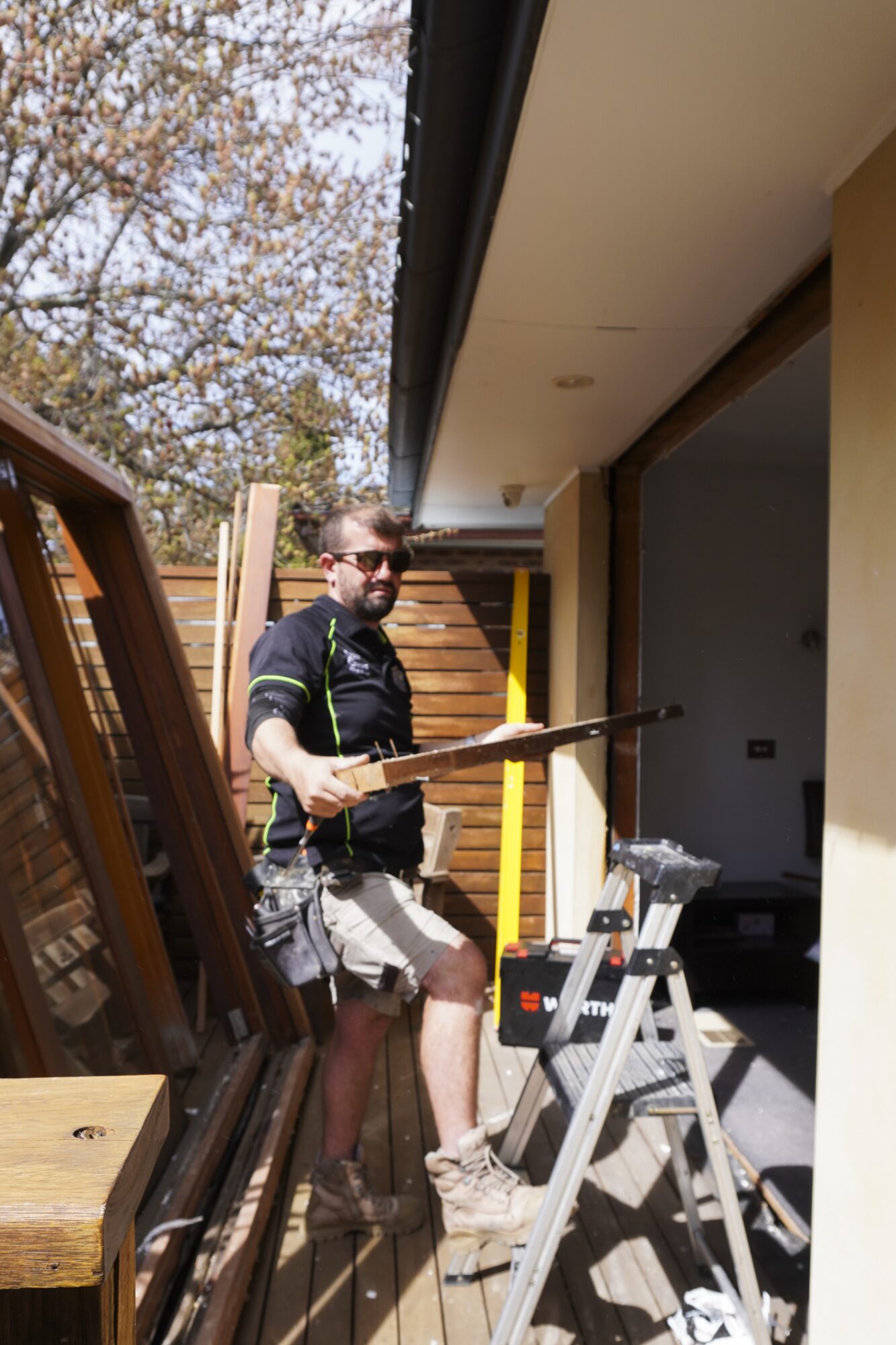
We aim to minimise disruption as much as possible. Here’s what to expect:
-
Installers work room-by-room to limit exposure and maintain privacy and all glass goes back in each afternoon on the items replaced.
-
Old windows are removed and taken off-site.
-
Dust sheets and drop cloths are used to reduce mess.
-
Some dust is unavoidable, but we vacuum and tidy before leaving.
-
Most installations take 1–5 days depending on the number of windows and doors.
-
You can stay in your home throughout the installation.
Our team is respectful, careful, and trained specifically in window replacement for lived-in homes.
How do I store my frames and glass?
Frames and glass are delivered on separate trucks and walked up into your designated storage area. They stack up neatly against each other on a wall.
- Glass requires padding such as cardboard, timber, rubber, or fabric underneath if it is going onto concrete.
- Glass and frames should be stored out of the elements, high traffic walk ways and pooling water.
- Glass and frames will only be stored on site for 1-5 days on average.
How long does an installation take?
Depending on the way your home is built, our teams usually install up to 4-6 items per day. Homes with double brick, timber or steel can often take longer.
Can I keep my old windows and doors to resell them?
In most cases, your old windows and doors are damaged when they are removed. Talk to our team during the check measure to see if we can take your old units out for resell. There is an extra charge as it takes longer to take them out carefully.
Can I replace my windows and doors in stages?
Yes, if you plan to replace in stages we highly recommend doing at least 4 windows and doors at a time due to minimum delivery and installation fees.
Can you make my window into a door?
Yes, we are able to alter the height the hole by cutting brick or cladding. If you require the width to be widened, we can work with and engineer and builder.
Can you add a window or door into a space that is just a wall?
If you require structural work such as cutting a hole into a wall for a window or door, we will need to enlist an engineer and builder to collaborate on your installation.
How do I clean and maintain uPVC windows and doors?
uPVC requires very minimal maintenance. To keep your windows performing well:
-
Clean the frames with mild soapy water (avoid harsh chemicals).
-
Clean glass with clear glass cleaner.
-
Lubricate moving parts and hinges once a year.
-
Keep drainage channels clear of debris.
That’s it no painting, sanding, sealing, or rust treatment required.
Double Glazing Glossary
Get familiar with the various industry terms that your builders and architects may use while installing double glazing in your new home or replacing existing windows and doors.
Accoustic Instulation
Acoustic insulation, such as double glazing, is used to reduce the nuisance caused by outside noise. Acoustic insulation works by reducing a sound wave’s energy.
AS3959
Australian Standard covering “Construction of buildings in bushfire-prone areas.“ Incorporates Bushfire Alert Level Ratings (BAL)
Bay Window
An angled combination of three windows that project out from the wall of the home. The windows are commonly joined at 30- or 45-degree angles.
Condensation
The accumulation of water vapours or droplets is the result of warm, moist air coming in contact with a cold surface and cooling to its dew point temperature. Condensation may occur when a cold window glass or frame is exposed to humid indoor air. Low-conductivity, insulated glass and warm-edge spacers reduce condensation. Read more about condensation.
Double Hung Window
A window that has two operable sashes which slides vertically.
French Door
A particular design of swing door, all or a large part consisting of divided glass panes. More information on door opening styles is available here.
I.G. Unit (Insulating Glass Unit)
Two or more plates of glass separated by a spacer and hermetically sealed at the glass edges.
Lintel
A horizontal framing member placed across the top of the rough opening of a window or door opening to prevent the weight of the wall or roof from resting on the window frame.
Mullion
A vertical or horizontal connecting unit between two or more windows.
Patio Door
A glass door that slides open and closes on adjustable tandem rollers. Available in 2- or 3-lite configurations with the operable panel available in any position.
Sill
The horizontal, bottom section of the main frame.
Slider Window
A window in which the sash move horizontally. Sliders are available in a 2- or 3-lite configuration, with the 3-lite having operable end vents
Spacer
Material placed between two or more pieces of glass in order to maintain a uniform width between the glass, and prevent sealant distortion.
Triple Glazing
Glazing that incorporates three panes of glass, enclosing two separate air spaces.
VCA
Vinyl Council of Australia. View the website
WERS
Australia’s Window Energy Rating Scheme
Air Space
The space in the cavity between two panes of glass in an insulated glass unit.
AGWA
Australian Glass and Window Association. View the AGWA website here.
Casement Window
Dorme
A space which protrudes from the roof, usually including one or more windows.
Fenestration
An architectural term referring to the arrangement of windows in a wall.
Gasket
A pliable, flexible continuous strip of material used to affect a watertight seal between a sash and frame much like the seal around a refrigerator door.
Jamb
Vertical sections of the main frame.
Low E (Emissivity) Glass
Glass with a transparent metallic oxide coating applied onto or into a glass surface. The coating allows short-wave energy to pass through but reflects long-wave infrared energy which improves the U-value.
Obscure Glass
Glass that has been made translucent instead of transparent.
Safety Glass
A strengthened or reinforced glass that is less subject to breakage or splintering, such as glass for storm doors and some windows
Single Hung Window
A window in which one sash slides vertically and the other sash is fixed.
Sloped Sill
The sill of the window that has a downward slope to the outside. This sill has sufficient degree of slope to aid in water runoff.
Tempered Glass
Glass with a surface compression of not less than 10,000 psi, or an edge compression of not less than 9,700 psi. When broken, the glass breaks into pebbles instead of shards
uPVCWA
UPVC Window Alliance. View the website.
Visible Light Transmittance
The percentage of light that is transmitted through glass in the visible light spectrum (380 to 720 nanometers). The higher the number the higher the percentage of visible light transmitted through the window.
Argon Gas
An odourless, colourless, tasteless, non-toxic gas that is six times denser than air. It is used to replace air between the glass panes to reduce temperature transfer.
Awning Window
A top-hinged window that swings outward for ventilation. View window opening styles here.
Clerestory
A window near the top of an outside wall.
Double Glazing
Glazing which incorporates two panels, separated with an air space, for the purpose of thermal and acoustic insulation.
Frame
That part of a window assembly surrounding the sashes or fixed glazing.
Glazing
The process of sealing the glass to the sash
Laminated Glass
Specially designed glass where two panes of glass are bonded to a durable interlayer, providing increased safety, UV protection and noise reduction. If the window or door gets broken the glass will adhere to the plastic interlayer-preventing glass fallout in the home.
Main Frame
The head, sill and jambs sections of a window.
Pane
A sheet of glass for glazing a window.
Sash
The part of the window which contains the glass.
Single-strength Glass
Glass with a thickness of approximately 3/32
Solar Heat Gain Coefficient (SHGC)
The percentage of heat gained from both direct sunlight and absorbed heat. The smaller the number, the greater the ability to reduce solar heat gain.
Tilt and Turn Windows
Windows with fittings that make it possible to rotate the window through 180º so that the exterior pane is facing inwards. This is very practical when washing windows. More window opening styles available here.
U-value
Amount of heat transferred through a material. The lower the U-value, the slower the rate of heat flow and the better the insulating quality.
Weep/ Drainage Holes
Slots or holes in the sill (bottom) member of the sash frame that allows water to escape. Weep flaps add a drainage cap to keep insects out
Get a Free Consultation
Solace Creations is dedicated to transforming your vision into reality. With our complimentary consultation, we tailor your quote to meet your unique design and performance needs.
Glass Types
Discover our range of double glazed glass units designed for your style and performance requirements
Opening Styles
Custom designed insulated windows and doors for each room in your home